

And How This Defines a New Aerospace Future for Winnipeg
General aviation manufacturers are currently presented with a deceptively simple choice. They can continue using turbine engines, or they can demonstrate their environmental credentials by adopting electric, hydrogen or hybrid-electric propulsion. For a new amphibious aircraft manufacturer, the decision may look like a black-and-white one, but it doesn’t have to be.
The Choice Between Proven Turbines and Sustainable Aviation
It’s not the first time that manufacturers of commercially operated aircraft have had to make a hard choice.
Continue with leaded-laced, gasoline-fueled, piston-driven, internal-combustion engines, or move on to jet-fueled turbine engines.
Then, when OEMs introduced commercially viable turbine-powered aircraft, operators had to make their decisions.
Sell their piston aircraft for $50,000 and replace it with a turbine-powered aircraft for upwards of $1,000,000.
The response took time, but the turbine, and more specifically the PT6, became the big winner.
When it comes to electrically driven propulsion, the practical decision is not whether aviation should eventually transition toward lower-carbon propulsion. It should. The real decision is how a new original equipment manufacturer can certify an aircraft, begin production, establish a customer base, and generate revenue without making its first aircraft dependent on technologies that may not yet provide the payload, range, reserves, infrastructure, or certification maturity required for demanding government and commercial missions. The most credible answer is a phased propulsion strategy.
The first production version of a new Canadian amphibious aircraft should be powered by a proven Pratt & Whitney Canada PT6. The aircraft should simultaneously be engineered so that future production versions can accommodate hybrid-electric systems, turbine-generators, hydrogen fuel cells or batteries when those technologies become operationally and commercially suitable. This is not an argument against electrification. It is an argument against making the success of an entire aircraft program dependent upon the least mature part of the design.
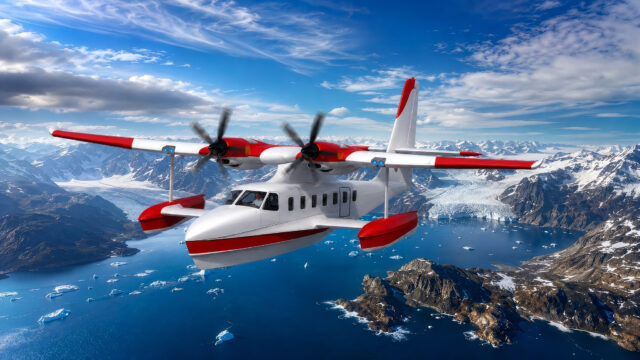
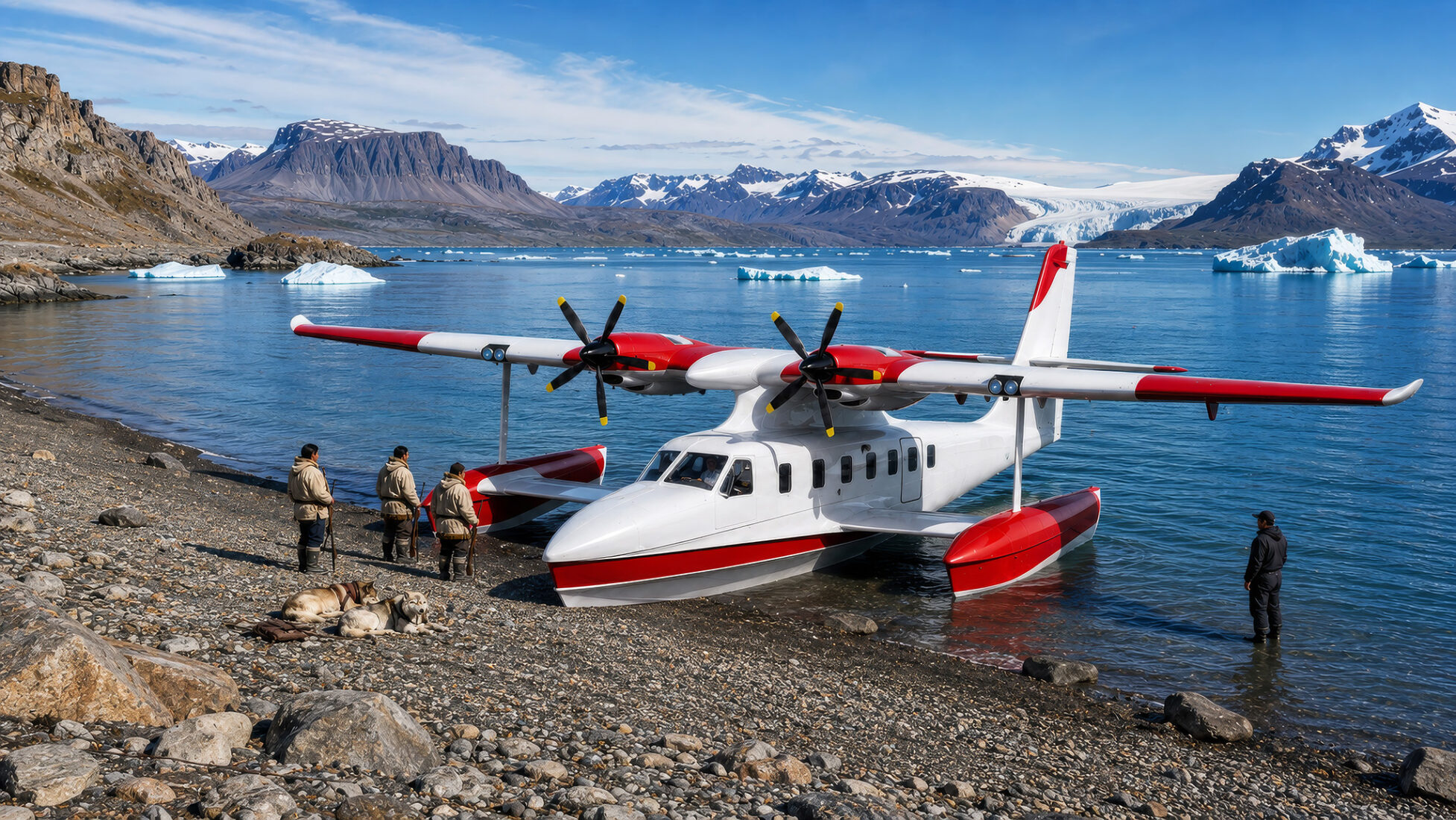
In my previous article, Jet Fuelling Canada’s Future, I made the broader case for using Canadian-built winter-capable amphibious aircraft to support coastal mobility, northern access, sovereignty and sustainable regional transportation. The Ocean 18, operated by the Canadian Coast Guard, the Air Force, and civilian air services, would complement, not replace, Canada’s existing fleet of Twin Otters, King Airs, helicopters, marine vessels, and other specialized platforms. Across an Arctic archipelago of immense distances, thousands of remote islands, and some of the longest and most operationally demanding coastlines in the world, the challenge is not the absence of individual assets; it is the absence of a practical link between them. A winter-capable Ocean 18 amphibious aircraft could become that missing link: the aerial connective tissue that joins northern communities, Coast Guard vessels, airfields, water bases, ports, medical services, surveillance systems, and search-and-rescue resources into a single integrated network.
From the East Coast up through the Hudson Strait into the North-West Passage, across the vast Arctic coastline to the fjords, inlets, islands, and remote settlements of the Pacific coast, the Ocean 18 could connect the components already in place and transform them into a genuinely national, year-round maritime and northern-response system.
This article narrows the discussion to which powerplant provides a Canadian-built amphibious Ocean 18, the most credible path to certification, the use of a reliable, proven Coast Guard service, and how that decision could support a full-service PT6 maintenance, repair, and overhaul (MRO) centre in Winnipeg.
The answer begins with the venerable PT6.
Certification Is the First Commercial Challenge
A new aircraft company does not create lasting value merely by producing drawings, renderings or a prototype. It creates value by obtaining a type certificate, establishing repeatable production, delivering aircraft to credible customers and supporting those aircraft throughout their operational lives. Every major unproven system introduced into the initial design creates another development and certification program inside the aircraft program.
A battery- or hybrid-powered amphibious aircraft must demonstrate much more than the efficiency of its electric motors. The manufacturer must substantiate the safety of the battery cells, battery-management system, high-voltage distribution network, inverters, thermal-management system, charging procedures, electrical isolation, electromagnetic compatibility, crashworthiness and emergency response arrangements. The manufacturer must also show that a battery failure, thermal event, water ingress or loss of cooling will not create an unacceptable hazard.
Amphibious operation compounds those challenges. Salt water is conductive and corrosive. High-voltage equipment must remain protected during spray exposure, docking, rough-water operations, minor hull damage and repeated transitions between water and land. Battery venting, firefighting access, emergency egress and post-accident recovery all require particular consideration.
A hybrid-electric aircraft retains many of these requirements while adding a turbine, generator or other onboard source of electrical energy. Instead of replacing the conventional propulsion certification burden, a hybrid system may initially combine it with the certification burden of high-voltage propulsion, batteries, power-management software and multiple operating modes. None of this means electric or hybrid aircraft cannot be certified. It means that the regulatory pathway is less mature, more program-specific and more difficult to forecast accurately in advance.
A PT6-powered aircraft still requires a complete aircraft certification program. The engine installation, inlet, exhaust, propeller, fuel system, controls, mounts, cooling, fire protection and performance must all be approved. The difference is that the underlying engine family already has decades of regulatory, operational and maintenance experience. A new OEM using a PT6 is not simultaneously trying to certify an unfamiliar airframe, an innovative hull and an entirely new means of propulsion. That distinction may determine whether a startup reaches production or remains an attractive prototype.
The PT6 Is Mature, Not Obsolete
Calling the PT6 a legacy engine can be misleading.
It is certainly mature. That maturity is one of its principal advantages. It does not mean development stopped decades ago. Pratt & Whitney Canada has progressively improved the family through better compressor efficiency, improved hot-section materials, higher power-to-weight ratios, digital monitoring, longer maintenance intervals, and more sophisticated engine management systems. The PT6 family has exceeded one billion flying hours and has been installed in more than 100 aircraft applications.
That installed base has created something no new propulsion startup can reproduce quickly: an international ecosystem of operators, engineers, overhaul facilities, field-service representatives, training organizations, parts suppliers, financiers and insurers. It also provides an enormous body of operational information.
Maintenance planners understand PT6 shop visits. Lessors understand residual values. Insurers understand the risk history. Operators understand fuel planning, starting procedures and performance degradation. Regulators understand the architecture. Pilots understand how the engine behaves. A startup using an unfamiliar powerplant must build much of that confidence from the beginning. A startup using a PT6 enters a market that already understands what it is buying.
The PT6A-34 and PT6A-140 are particularly relevant to the Ocean aircraft family. The PT6A-34 is a well-established 750-shaft-horsepower engine associated with aircraft such as the Series 400 Twin Otter and other utility platforms. The PT6A-140 produces 867 shaft horsepower and is best known for powering the Cessna Grand Caravan EX. Both are proven members of the same engine family. The question is not whether either can power a utility aircraft. The question is which variant gives the Ocean 18 the best balance of certification risk, acquisition cost, operating cost and mission capability. That decision was supported by and based on a formal engineering and operational trade study. Note to pilots: It should not be made from brochure horsepower alone.
Nevertheless, for a twin-engine Canadian Coast Guard aircraft intended to operate at high weights, in cold weather, over rough water, and with mission equipment installed, additional power warrants serious consideration. More about that later.
Western Canada Already Operates a PT6 Economy
The business case for a Winnipeg-based PT6 overhaul center does not depend upon the future Ocean 12 or Ocean 18. It begins with aircraft already operating. Western and Northern Canada host a substantial fleet of PT6-powered King Airs, Pilatus PC-12s, Cessna Caravans, Twin Otters, agricultural aircraft, firefighting aircraft, and specialized government or commercial platforms. These aircraft support air ambulance services, northern passenger transportation, resource development, government travel, corporate charter, firefighting, surveillance, cargo operations and access to communities with limited road connections.
The King Air 200 and B200 families are closely associated with the PT6A-41 and PT6A-42 engines, while later B200GT and King Air 250 variants use the PT6A-52 engine. The Pilatus PC-12 fleet has used PT6A-67-series engines, with the latest PC-12 NGX adopting the digitally controlled PT6E-67XP.
Manitoba operators provide visible examples.
Keewatin Air, for example, operates King Air B200 and Pilatus PC-12 aircraft in demanding northern aeromedical and charter services. Fast Air and Missinippi Airways, operating B200S, contribute another part of the regional ecosystem through charter, medevac, maintenance, aircraft management and fixed-base operations. Northway Aviation and Adventure Air both operate a mix of Cessna C208 and C208B-EX on amphibious gear during the summer and fixed gear during the winter. The same pattern extends west through Saskatchewan, Alberta and British Columbia, east into Northwestern Ontario, and north into the territories.
Pratt & Whitney remains an important part of Manitoba’s aerospace industry. The present argument is not that the company Standard Aero, which provides world-class overhaul facilities for many Pratt & Whitney engines, has abandoned Manitoba – it hasn’t, and it continues to provide robust services for the larger P&W engines. It is that Western Canada no longer appears to have a full-service overhaul facility focused on the smaller PT6 variants used by many King Air, Caravan, Twin Otter, and utility aircraft operators. Those operators must often move engines considerable distances for major shop work. Geography matters when a turbine engine is removed.
The operator must preserve the engine, arrange an approved shipping stand, organize freight and insurance, coordinate a replacement engine if one is available, manage records and schedule removal and reinstallation around the overhaul shop’s capacity. For a charter operator, that inconvenience costs money. For a medevac, firefighting, government or remote-service operator, it may reduce the availability of an essential public service. A Winnipeg facility would shorten that chain and provide a more tailored service for operators in the western and Arctic regions.
The PT6 and the Sustainable Aviation Transition
A decision to begin with the PT6 should not be characterized as a rejection of sustainability. It is a way to make measurable progress without postponing aircraft production until every future propulsion technology is ready. Sustainable aviation fuel can be used within existing turbine aircraft architecture when it meets the applicable fuel specifications, blend limits, and engine manufacturer requirements. SAF does not eliminate emissions at the exhaust. Its potential benefit is measured across the fuel lifecycle, including feedstock, production, transportation and the amount of fossil-derived fuel displaced.
No responsible solution should assign a single universal emissions-reduction percentage to every type of SAF. The result depends upon how the fuel is produced. The strategic advantage is nevertheless important. SAF allows an existing turbine-powered fleet to participate in the emissions transition without replacing every aircraft, powerplant, fuel system and airport distribution network. The PT6 family has also continued to evolve.
Pratt & Whitney’s PT6 E-Series introduced integrated electronic propeller and engine control, longer scheduled maintenance intervals, improved monitoring, and a longer time between overhauls in its initial application. Those features demonstrate that Pratt & Whitney is not standing still while other companies develop electric systems.
The turbine may also remain relevant inside future hybrid aircraft. A smaller turbine operating as a generator or range extender could supply electrical power while batteries provide short-duration takeoff or climb assistance. For a future Ocean aircraft, that could eventually mean electric propulsion motors supported by a smaller onboard turbine operating at a stable, efficient power setting. The first PT6-powered aircraft would therefore not be a dead end. It would be the aircraft that establishes the hull, aerodynamics, systems architecture, market and support network from which later propulsion versions can develop.
Why the Ocean 18 Changes the Amphibious Aircraft Discussion
Conventional floatplanes and older flying boats carry an unavoidable hydrodynamic penalty. Before takeoff, the aircraft must accelerate through displacement, transition and planing regimes. Considerable power is required to overcome water drag (wetting) before the aircraft reaches flying speed. Ocean Aircraft offers a distinct hull philosophy, grounded in the proven success of hyper-engineered sailing vessels that use advanced aerodynamics and hydrodynamics to routinely sail three times faster than the wind. Much of that success is attributed to the use of trimaran extreme multi-hulls. Put that hull on a flying boat and see what you get.
The British Ocean aircraft designer James Labouchere states that its hull form can reduce hydrodynamic drag during takeoff by approximately 40 percent and avoid the pronounced “drag hump” associated with conventional designs. He also claims that reduced cruise drag, propeller slipstream flaps, and lift generated by stub wings in the ground effect will improve useful load and payload-range performance. These manufacturer claims have been demonstrated through scale model testing. The hull performance, like the modern sailboat’s dependence on rigid hyper-airfoil sails, nevertheless is directly related to engine selection. The power-to-weight ratio reigns supreme in maximizing both the aircraft’s lift and ability to overcome drag. A lower-drag hull does not make takeoff power unimportant. It changes what the aircraft can do with that power.
Instead of using a large proportion of available thrust merely to overcome inefficient water resistance, the aircraft can convert more of it into acceleration, shorter water runs, higher operating weights and improved margins. James also states that his hull is designed to penetrate waves, dampen pitching, and reduce shock loading, with the goal of operating in substantially higher wave conditions than conventional seaplanes. This ability to handle higher, steeper waves than a standard floatplane can is especially relevant to the Canadian Coast Guard.
A coast guard aircraft cannot be designed exclusively around inland lakes. It may be expected to operate along exposed shorelines, in coastal weather and in conditions where wave height, wind, cold temperatures and limited diversion options define the mission. The aircraft’s ability to land in rougher water is only useful if it can also take off again with an appropriate payload and reserve. Power therefore remains part of the safety margin.
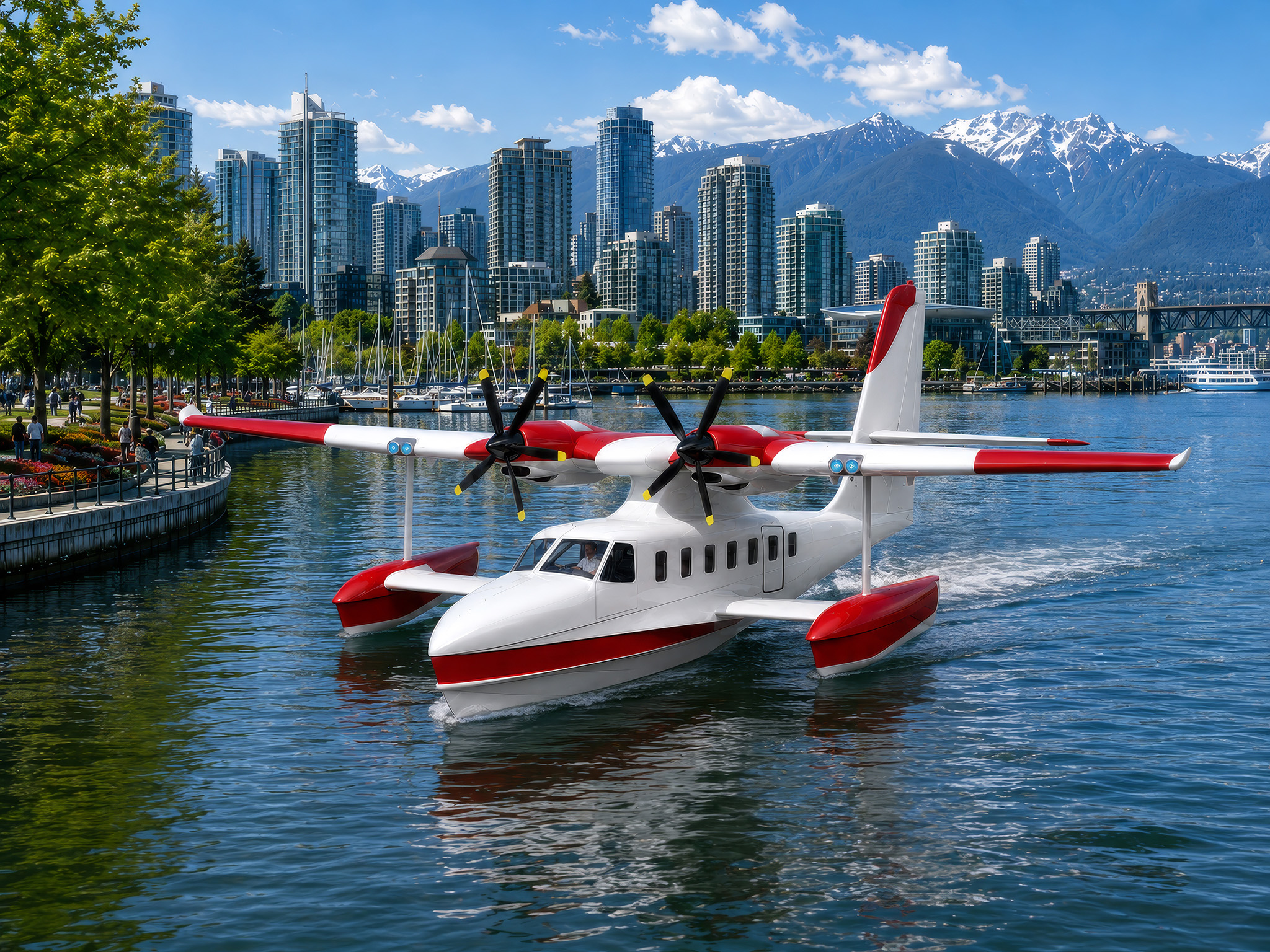
Ocean’s proposed folding-wing arrangement and electric water thruster provide another useful distinction. With the wings folded, the aircraft would maneuver into docks, marinas, harbours, or sheltered maintenance locations without relying solely on aerodynamic control or propeller thrust. The water thruster will be electric even when the primary flight engines are turbines. This provides a practical early step toward quieter, lower-emission harbour operations without making the entire aircraft dependent upon battery propulsion. That is exactly what a phased technology strategy should look like.